
LHCb finds first evidence of an extremely rare particle decay
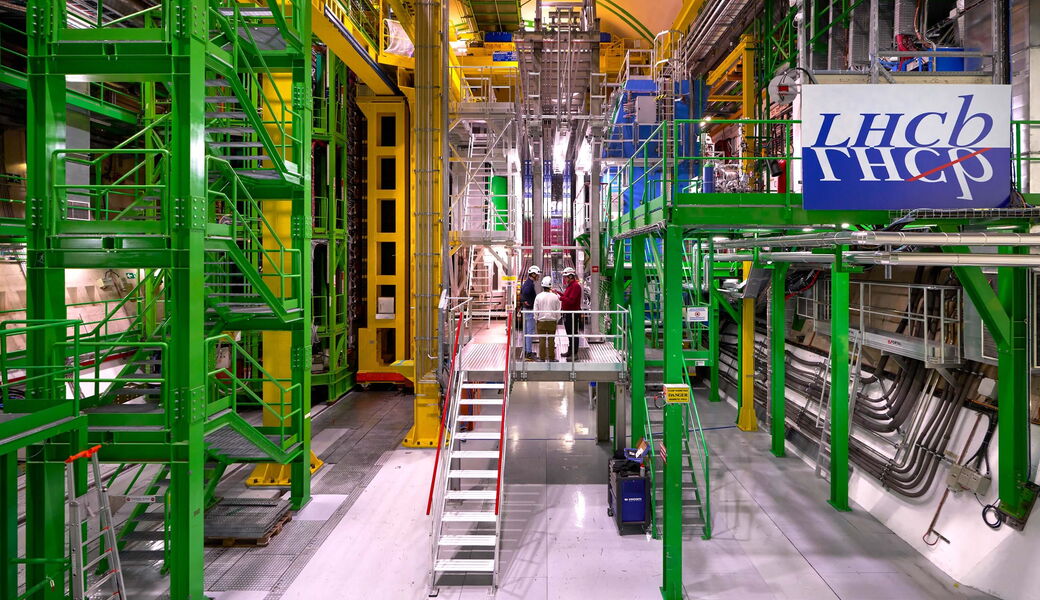
After decades of searching: The LHCb experiment at CERN has found the first evidence of the extremely rare decay of a neutral B0 meson into two muons. At the same time, the collaboration has achieved the most precise measurement to date of the related decay of the B0s meson into two muons. These results mark an important milestone in the search for New Physics beyond the Standard Model of particle physics. Researchers from Germany, funded by the BMFTR, have made major contributions to the measurements.
Exploring the Universe's unanswered questions
Why is there more matter than antimatter in the Universe? What is dark matter made of? And are there particles or forces that have yet to be discovered? Despite its many successes, the Standard Model of particle physics cannot answer some of the most fundamental questions about our Universe.
Researchers are therefore searching for signs of New Physics at the Large Hadron Collider (LHC) at CERN. Like a microscope, the LHC allows scientists to probe the structure of matter at extremely small length scales, far below the size of an atomic nucleus. Yet new particles and forces could exist at even smaller scales, potentially reaching down to the zeptometer range, sometimes referred to as the Zeptoverse. Such particles could influence known particle processes through quantum effects. These influences could manifest themselves as measurable deviations from the predictions of the Standard Model.
The rare decays of so-called B mesons are particularly sensitive to such effects. These short-lived particles consist of a quark and an antiquark, one of which is a heavy beauty quark (or bottom quark). The LHCb experiment is specifically designed to study B mesons and their decays with high precision.
Extremely rare decays could reveal New Physics
B mesons are produced in large numbers in LHC collisions but decay almost immediately. Particularly informative are decays into two muons, the heavier, electrically charged relatives of electrons.
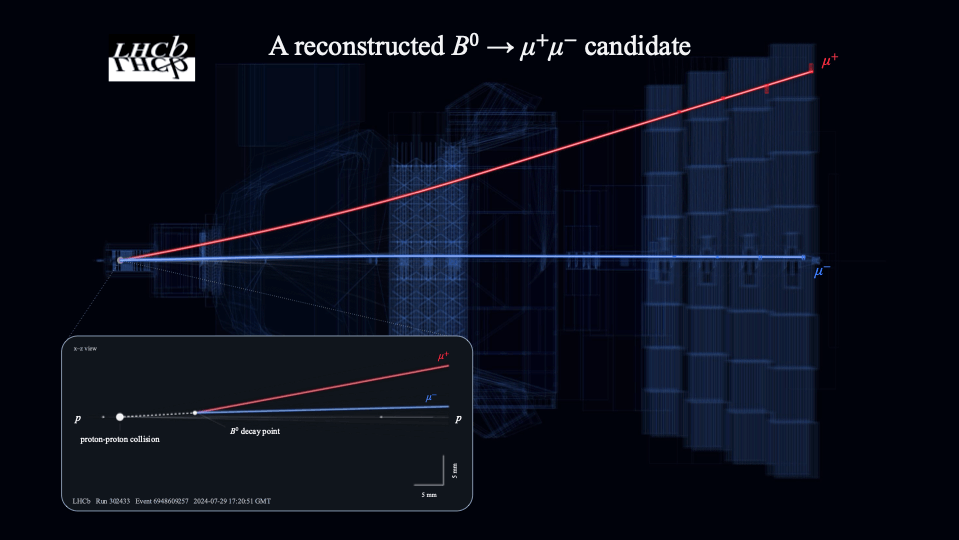
The researchers studied two such decays: B⁰s → μ⁺μ⁻ and B⁰ → μ⁺μ⁻. Both mesons contain a beauty antiquark, together with a strange quark (B⁰s) or a down quark (B⁰). The Standard Model predicts about three B⁰s decays per billion B mesons produced and roughly one B⁰ decay per ten billion, because both proceed through quantum loops involving heavy particles such as the W and Z bosons and the top quark.
Yet this rarity makes the decays particularly sensitive probes of New Physics: unknown particles such as additional Higgs bosons or supersymmetric particles could contribute to the quantum processes and change the decay probabilities, even if they cannot be produced directly at the LHC. For decades, these decays have therefore been regarded as golden channels in the search for New Physics beyond the Standard Model.
A new milestone for LHCb
An important breakthrough came in 2015, when LHCb and CMS jointly established the decay B0s → μ⁺μ⁻ (see the Nature publication here). Since then, LHCb, CMS and ATLAS have continued to measure this process with increasing precision. However, the even rarer related decay B0 → μ⁺μ⁻ had not yet reached the level of evidence in an individual analysis.
LHCb has now made a significant advance: the collaboration has found the first evidence of this decay. The statistical significance of the signal is 3.2 sigma, exceeding the conventional threshold for evidence in particle physics. A discovery generally requires a significance of five sigma.
But there is more: the same analysis also achieved the most precise measurement to date of the B0s → μ⁺μ⁻ decay. In addition to its decay rate, the effective lifetime of the decay was measured with greater precision.
An important contribution from TU Dortmund
The results are currently consistent with the predictions of the Standard Model and place important constraints on models that predict new particles and interactions. They also demonstrate the potential of combining improved detectors, larger datasets and modern analysis techniques for precision physics.But this does not mean that the search for New Physics is over, because: the more precisely researchers measure rare decays, the more sensitive their tests of the Standard Model become.
The planned High-Luminosity LHC (HiLumi LHC), which is expected to deliver significantly more collisions from 2030 onwards, will play an important role. To take full advantage of the additional data, the LHCb experiment will also be further upgraded. A comprehensive upgrade, LHCb Upgrade II, is scheduled for the LHC's fourth long shutdown (LS4), beginning around 2035.
Researchers from the German LHCb community also made major contributions to the new measurements. The Technical University of Dortmund, which is one of the partner universities of "Color meets Flavor" Cluster of Excellence, played an important role. Particularly through the research group of Prof. Dr. Johannes Albrecht, who is also designated spokesperson of LHCb Germany. His research group has been studying rare B-meson decays for many years. Regarding the breakthrough, he says:
“My research group and I have been working on searching for and measuring the decays B0s → μ⁺μ⁻ and B0 → μ⁺μ⁻ for almost 20 years. This first evidence of B0 → μ⁺μ⁻ now opens up an entirely new, theoretically very clean window onto physics beyond the Standard Model. However, it will require the data we aim to collect with LHCb Upgrade II through 2041 to measure this system precisely. There is now great discovery potential, particularly in measuring the B0s and B0 decays simultaneously.”
Dr. Mick Mulders from this group, whose work is funded by the BMFTR through the LHCb ErUM-FSP, just presented the new results on behalf of the LHCb collaboration for the first time at a CERN seminar on 3 November. He said: “I had the honor of presenting the new results on the decays B0s → μ⁺μ⁻ and B0 → μ⁺μ⁻ on behalf of the LHCb collaboration. A large part of the work comes from our team in Dortmund, together with colleagues from Italy and the UK. I find it extremely exciting that we have found evidence for the decay B0 → μ⁺μ⁻. This demonstrates the quality of the data from LHCb Upgrade I and is just the beginning of many more exciting results.”
The results exemplify the sustained research efforts and international collaboration required to achieve such challenging measurements. German research groups contribute their expertise in areas including detector development, data analysis, software and computing.
The LHCb upgrade makes the difference
The new results were made possible in part by the extensive upgrade of LHCb during the LHC’s second long shutdown (LS2) from 2019 to 2022. It enables the experiment to handle significantly higher collision rates, record more data and detect and distinguish particles more precisely. One example of Germany’s strong involvement is the SciFi (Scintillating Fibre) Tracker, LHCb’s completely renewed central tracking system, which has been providing reliable tracking data since it began operation in 2022.
The analysis combines data from 2011 to 2018 with a large amount of new data recorded by the upgraded LHCb in 2024 and 2025. Modern techniques, including machine learning, help distinguish the extremely rare decays from many other particle processes. The results are consistent with the Standard Model and place important constraints on models predicting new particles and interactions.
The search for New Physics continues: with additional data, more powerful detectors and increasingly sophisticated analysis techniques, rare B-meson decays could provide crucial clues to the Universe’s unanswered questions.
You can find the presentation slides and the webcast of the CERN seminar on the new LHCb results here.