
Inauguration Ceremony for “Color meets Flavor” in Bonn
Cutting-edge research “made in NRW”: The “Color meets Flavor” Cluster of Excellence was officially launched in Bonn. Teams from the universities of Bonn, Siegen, and Dortmund, along with the Jülich Research Center, are jointly investigating the strong and weak interactions of quarks and the origins of the universe.
Why is there an imbalance between matter and antimatter in the universe? How do various forces affect this, and what lies behind dark matter, which is believed to make up the majority of matter in the universe? With these fundamental questions about the nature of the universe, the new Cluster of Excellence “Color meets Flavor” is investigating new fundamental physical phenomena arising from strong and weak interactions between quarks. The cluster enables cutting-edge scientific research in the field of particle physics—with participation from the Universities of Bonn and Siegen, TU Dortmund University, and the Jülich Research Center.
On July 1, the Cluster of Excellence was officially inaugurated in the presence of Ina Brandes, Minister of Culture and Science of the State of North Rhine-Westphalia; Prof. Dr. Stefanie Reese (President of the University of Siegen); Prof. Dr. Dr. h.c. Michael Hoch (President of the University of Bonn), and Prof. Dr. Manfred Bayer (President of TU Dortmund) in the Wolfgang Paul Lecture Hall at the University of Bonn. Back in May 2025, the “Color meets Flavor” project received a funding commitment of approximately 45 million euros for a period of seven years from the Federal-State Commission for Excellence—and on January 1, 2026, the researchers began their work.
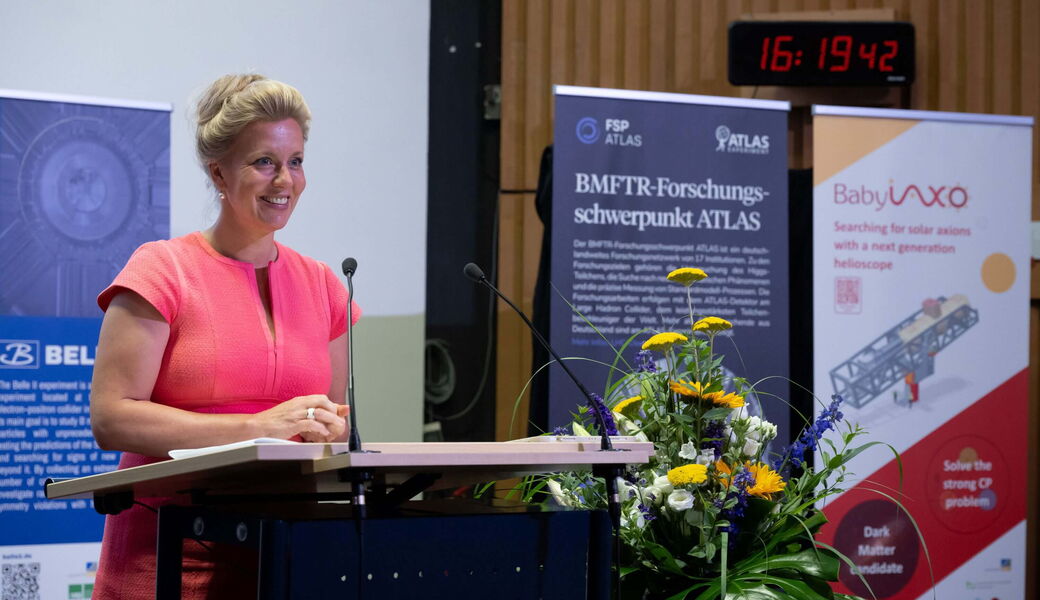
Minister of Science Ina Brandes: “The ‘Color meets Flavor’ Cluster of Excellence is an impressive example of the strength of basic research in North Rhine-Westphalia. The question of matter versus antimatter—that is, why things exist rather than simply nothing—remains an unsolved mystery of our universe. The joint Cluster of Excellence involving the Universities of Bonn and Siegen, TU Dortmund, and the Jülich Research Center is a flagship for cutting-edge research ‘made in NRW.’”
“The ‘Color meets Flavor’ Cluster of Excellence embodies a pure joy in science, cutting-edge research, and a truly international approach. It is dedicated to the great open questions of our existence—such as how matter arises, what fundamental forces and mechanisms are at work, and how we can further unravel nature’s still-unsolved mysteries,” emphasized Bonn University Rector Prof. Hoch. “The launch of our eighth Cluster of Excellence is a very special moment for us and, at the same time, a strong testament to the excellence of the research landscape in North Rhine-Westphalia. This is particularly evident in the exceptionally close collaboration among the four sites, as well as in the successful mix of young and experienced researchers who are driving this project forward.”
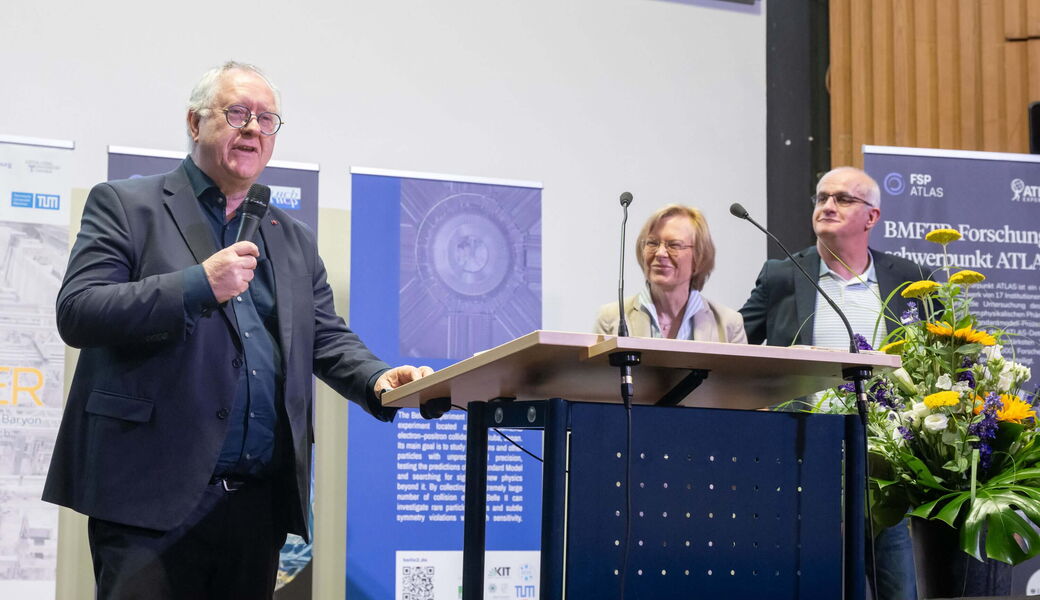
Prof. Dr. Stefanie Reese, Rector of the University of Siegen, says of the official launch of the research: “Being part of the ‘Color meets Flavor’ Cluster of Excellence is a historic moment for the University of Siegen, and we are absolutely thrilled. This makes us one of the few young universities in Germany—formerly comprehensive universities—to have achieved this status. I would like to extend my special thanks to Prof. Alexander Lenz, the cluster spokesperson from the University of Siegen, as well as to Prof. Thomas Mannel, who handled all the grant applications and made our participation in the Cluster of Excellence possible in the first place.”
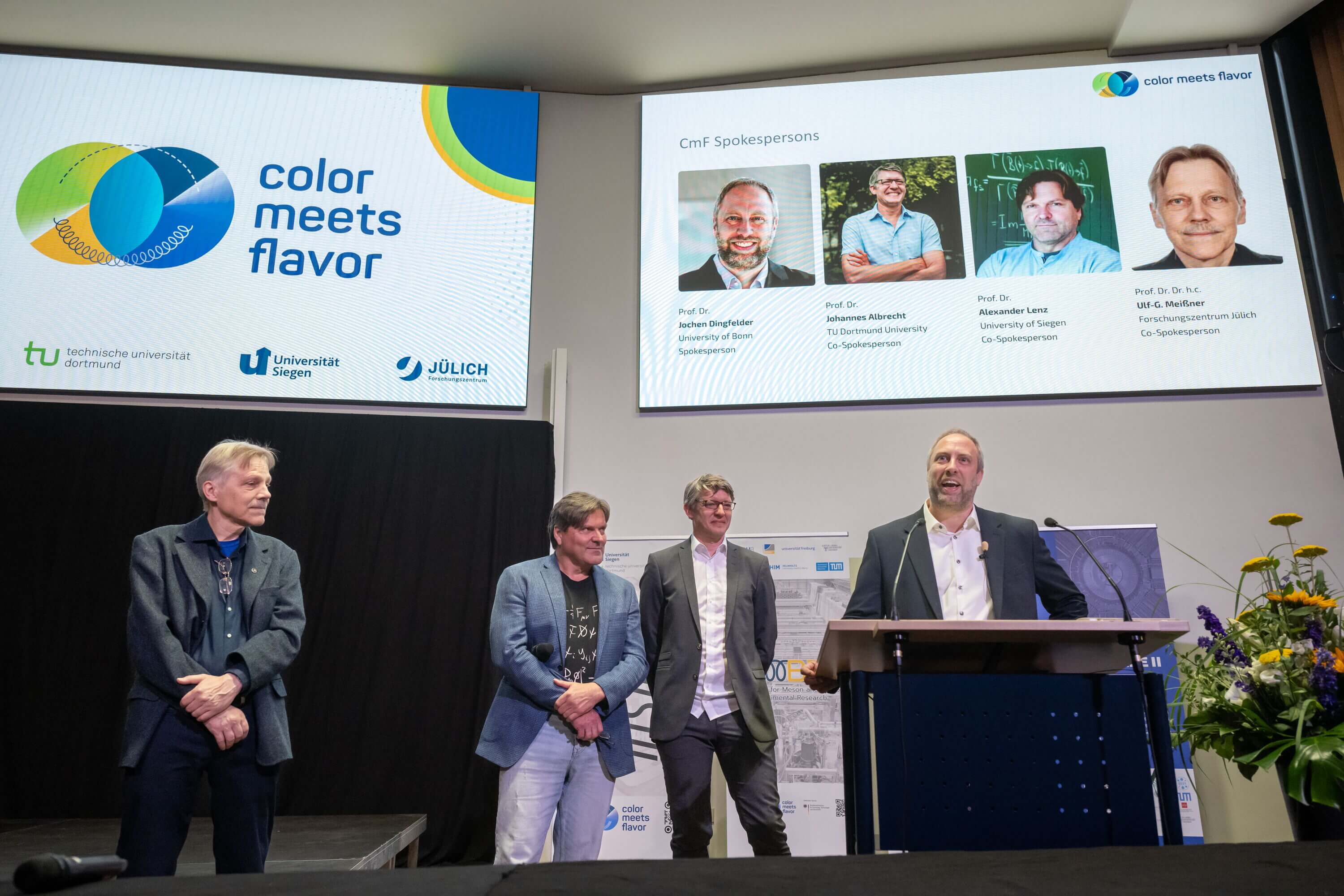
Cluster spokesperson Prof. Dr. Jochen Dingfelder (University of Bonn) described the two-year application process as an adventure: “We’ve shared unforgettable moments together and managed to develop a fully-fledged cluster from a promising idea. It’s based on many years of scientific collaboration in various areas of particle physics—and, above all, on a long-standing friendship. That is why we believe this cluster was long overdue.”
Prof. Dr. Alexander Lenz, co-spokesperson for the cluster at the University of Siegen, praised the strong momentum behind the research: “I’d like to thank our leadership for their excellent support. Four years ago, we came to Bonn and first introduced the concept of ‘Color meets Flavor.’ At that time, aside from our team, no one else knew exactly how ‘colors’ and ‘flavor’ were related to physics. Nevertheless, you believed in us from the very beginning, and that means a great deal to us. We are now looking forward to the years ahead together, with many new and exciting results. With two new cluster professorships—Prof. Simon Plätzer for Computational Physics and Prof. Matthias Hamer for Detector Physics—we have significantly expanded our scientific portfolio in Siegen and will use this to become even more attractive to students.”
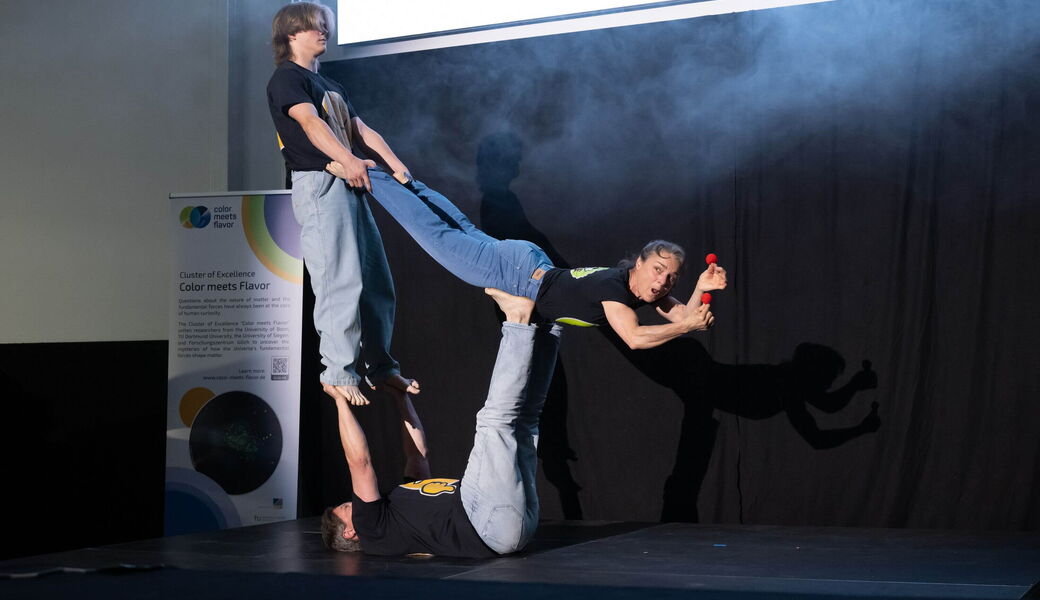
Physics with Acrobatic Interludes
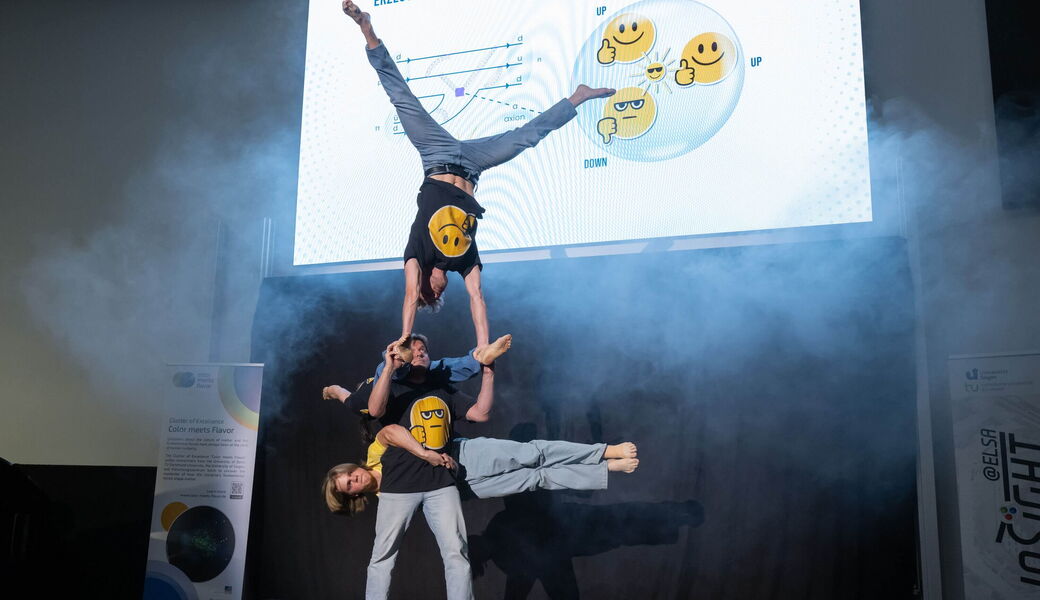
The scientists gave it their all when presenting their research. After the cluster’s four main areas of focus had been explained in theory, cluster co-spokesperson Prof. Dr. Alexander Lenz (University of Siegen) and his family—known as the performance group “Formafortis”—demonstrated the particle processes through acrobatics. Dressed as quarks—the fundamental elementary particles that make up the matter of the universe—they demonstrated how the up, down, strange, beauty, charm, and top quarks interact with one another.
At information booths in the foyer of the Wolfgang-Paul Lecture Hall, all guests were then able to learn more about the cluster’s research projects, such as the flagship project INSIGHT, to which all four cluster partners are contributing. INSIGHT is being set up at the ELSA electron stretcher facility at the University of Bonn—the highest-energy accelerator at any European university. The experiment aims to investigate the properties of baryons—a family of particles that includes protons and neutrons—with significantly greater precision, in order to better understand, in particular, baryons containing so-called “strange” quarks (strangeness). Research on this topic is being conducted in Siegen at the new INCYTE building.
Background: “Color” and “Flavor” in Physics
The name of the Cluster of Excellence “Color meets Flavor” stands for two fundamental forces of nature: the strong interaction (“Color”) and the weak interaction (“Flavor”). Particle physicists at the four locations aim to investigate the interaction between the strong and weak forces in order to discover new physical phenomena.
The focus is on quarks—the fundamental building blocks of matter. The strong interaction holds them together and forms hadrons such as protons and neutrons—the stuff that makes up atomic nuclei. The weak interaction, on the other hand, is responsible for allowing particles to change their type (“flavor”)—for example, when a neutron decays into a proton, an electron, and an antineutrino. Such processes provide important clues about the properties of particles—and possibly about as-yet-undiscovered particles. The Cluster of Excellence is also investigating the properties of the Higgs boson and searching for the axion, a hypothetical particle that plays a role in the strong interaction and could be a candidate for dark matter.