
IAL Research Fellowship
The Cluster of Excellence “Color meets Flavor” (CmF) invites applications for up to three fellowship positions (2+1 years each, subject to performance and the availability of funding) within the “Innovative Algorithm Lab” (see below). Fellows will define their own research agenda in line with the scientific aims of CmF and will select two CmF principal investigators as mentors. The fellowships focus broadly on numerical methods for CmF research and may address experimental needs, such as reconstruction and data analysis based on machine-learning methods, as well as algorithms and implementations on the theoretical side, for example, quantum algorithms for lattice field theory.
All positions are expected to start in 2026 and will remain open until filled.
Each position can be based at any of the four CmF sites: the University of Bonn, TU Dortmund University, the University of Siegen, or Forschungszentrum Jülich. Beyond CmF, fellows will be embedded in a strong local research environment that includes, for example:
- Bethe Center for Theoretical Physics (BCTP)
- Hausdorff Center for Mathematics (HCM)
- Electron Stretcher Facility (ELSA)
- Research and Technology Centre for Detector Physics (FTD)
- Jülich Supercomputing Centre (JSC)
- Lamarr Institute for Machine Learning and Artificial Intelligence
- DFG CRC 1639 “NuMeriQS”
The CmF research groups are involved in a wide range of international experiments, such as AMBER, ATLAS, BabyIAXO, Belle II, INSIGHT@ELSA, LHCb, and SupAX.
Candidates should have:
- a PhD in physics, computer science, mathematics, or a closely related field; and
- an established track record in their chosen field of research.
We offer:
- an excellent and stimulating research environment;
- the possibility to shape one’s own research agenda;
- strong support through the CmF mentorship program;
- comprehensive training opportunities;
- the opportunity to teach;
- comprehensive public health insurance and support structures at all sites;
- dedicated support for international hires (e.g., assistance with government procedures and onboarding);
- 30 days of annual leave; and
- flexible work arrangements.
Salary and social benefits are provided in accordance with the Collective Agreement for the Public Service (TVöD/TV‑L, pay grade E14).
We welcome applications from individuals with diverse backgrounds, for example, with respect to age, gender, disability, sexual orientation or identity, and social, ethnic, and religious origin. We are committed to providing a diverse and inclusive working environment with equal opportunities in which everyone can realize their potential.
For further inquiries, do not hesitate to contact the current IAL leaders, Florian Bernlochner and Stefan Krieg.
Innovative Algorithms Lab (IAL)
The mission of the Innovative Algorithm Lab (IAL) is to develop cutting-edge algorithms through multidisciplinary, multi-experiment, and theory-experiment collaborations across CmF, in particular with the Cluster's Technology Area 1 and the Intelligent Hardware Lab (IHL).
Computational methods are integral to nearly every aspect of CmF.
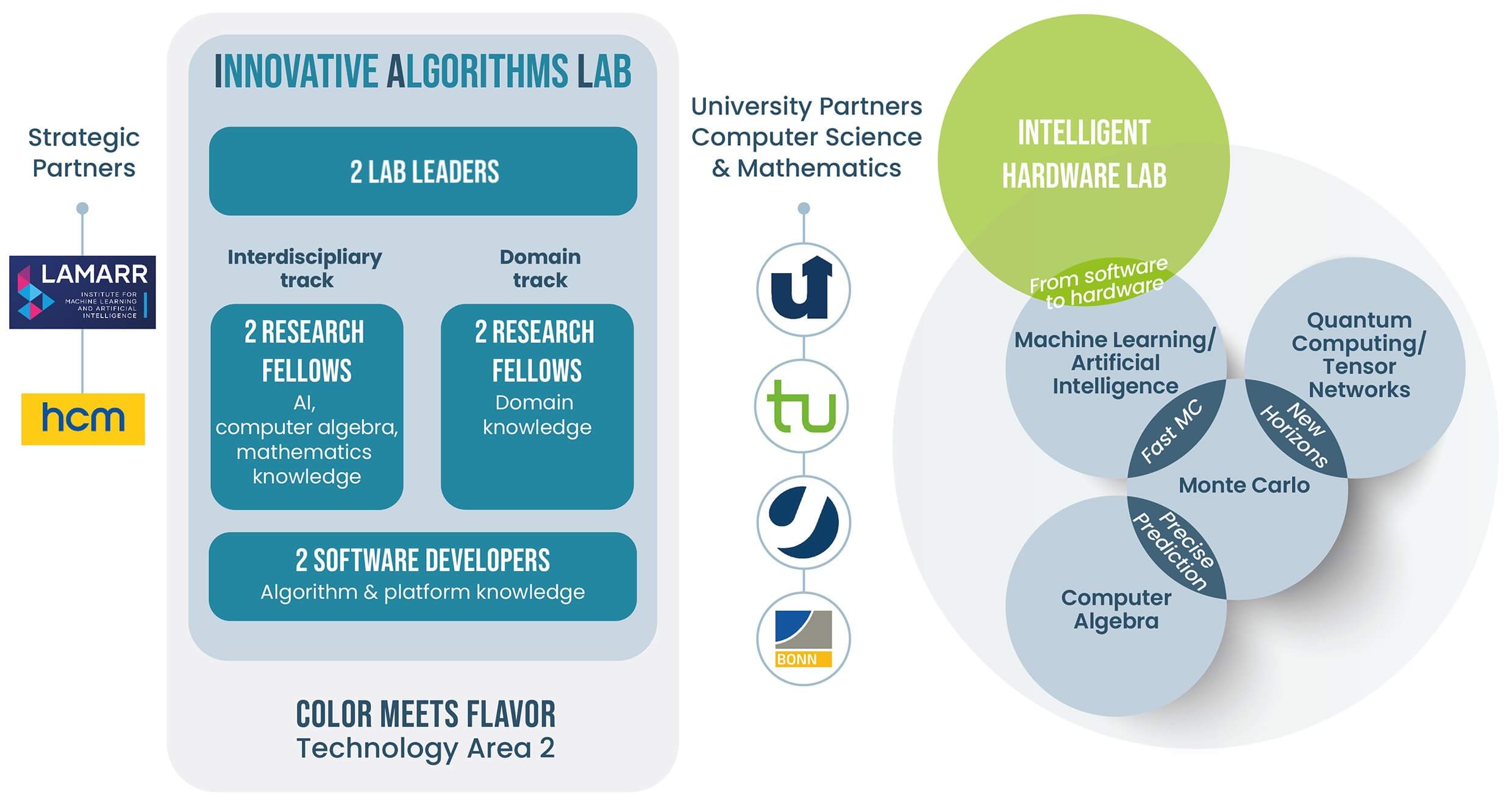
The IAL will bridge domain-specific knowledge with algorithmic expertise from computer science and mathematics. It operates in close partnership with the Lamarr Institute for Machine Learning and Artificial Intelligence and the Hausdorff Center for Mathematics (HCM). This effort builds on collaborations with principal investigators from the DFG CRC 1639 NuMeriQS “Numerical Methods for Dynamics and Structure Formation in Quantum Systems”, and FOR 5582 “Modern Foundations of Scattering Amplitudes”. The IAL is currently led by the principal investigators Florian Bernlochner and Stefan Krieg.
The postdoctoral IAL Research Fellows can freely choose their research direction within CmF. Fellows should be eager to develop novel methods and apply them to the cluster’s physics challenges. For researchers from interdisciplinary fields, the IAL will provide access to unique data samples, enabling them to train and implement cutting-edge algorithms to address physics questions. For those with specialized domain knowledge in physics, the IAL will offer algorithmic expertise and support. Our fellows will collaborate with leading experts from CmF, have access to cluster resources, and contribute to advancing CmF’s research agenda.
Infrastructure
The Jülich Supercomputing Centre (JSC) will allocate substantial computational resources to support the cluster’s goals, with dedicated assistance from the Simulation and Data Lab (SDL) "Numerical QFT". At Bonn, the High-Performance Computing and Analytics Lab (HPC/A Lab) will collaborate closely with the IAL. Low-threshold access to HPC resources, supplementing the JSC offerings, is available at the university computing center (HRZ). In Dortmund, the Lamarr DGX GPU Cluster and significant local CPU and GPU resources at the physics department are available.